NEW GENERATIONS OF ANTIBODIES AND SCAFFOLD PROTEINS AS A WAY TO CREATE HIGHLY SELECTIVE CONJUGATES FOR ONCOLOGY
Institute of Biological Instrumentation, Federal Research Center “Pushchino Scientific Center for Biological Research” of the Russian Academy of Sciences, 142290, Russian Federation, Moscow Region, Pushchino, Institutskaya St., 7, e-mail: loskutova-i@mail.ru
Keywords:antibody-drug conjugates (ADC), targeted therapy, bispecific antibodies, small scaffold proteins, linkers, cytotoxic agents, site-specific conjugation, PROTAC
DOI:10.18097/BMCRM00305
This review provides a systematic analysis of modern strategies for developing highly selective therapeutic conjugates for oncology. It examines the evolution from first-generation antibody-drug conjugates (ADCs) to advanced next-generation platforms. The focus is on key conjugate components: targeting modules (bispecific antibodies, small scaffold proteins — affibodies, DARPins, adnectins), linker systems with controlled release, and an expanding arsenal of cytotoxic and cytomodulatory payloads. Special attention is given to innovative technologies, such as PROTAC-ADCs, oligonucleotide conjugates, and photoimmunoconjugates, which enable targeting of "undruggable" molecules and manipulation of intracellular processes. Strategies for site-specific conjugation to obtain homogeneous preparations are analyzed. The conclusion is drawn that the convergence of refined components and novel platforms shapes the future of targeted therapy, aimed significantly at enhancing the therapeutic index and overcoming drug resistance.
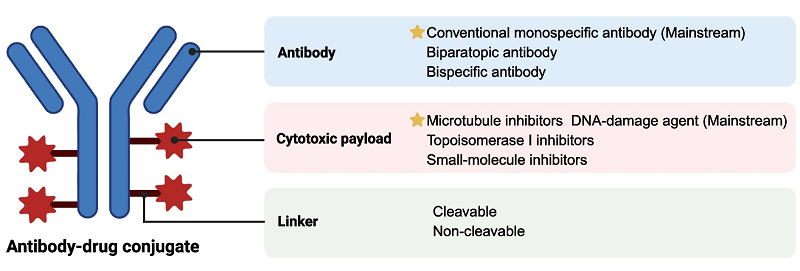
|
Figure 1.
Structure of an antibody-toxin conjugate. ADCs consist of three main components: a monoclonal antibody for specific interaction with receptors on the surface of tumor cells, a cytotoxic substance for destroying tumor cells, and a chemical linker that regulates the release of the drug, adapted from [8] (CC BY-SA 4.0).
|
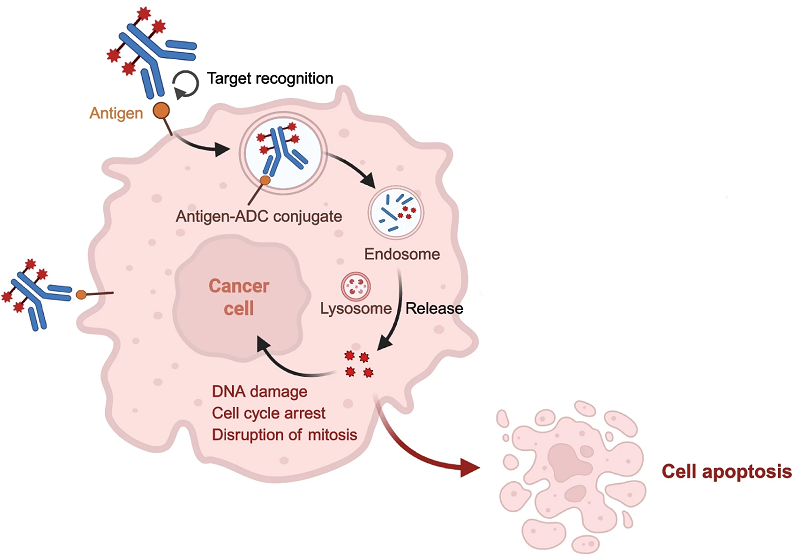
|
Figure 2.
Mechanism of action of ADC. It involves three main stages: binding to the receptor, internalization into the cell, release of the toxic agent. Adapted from [8] (CC BY-SA 4.0).
|
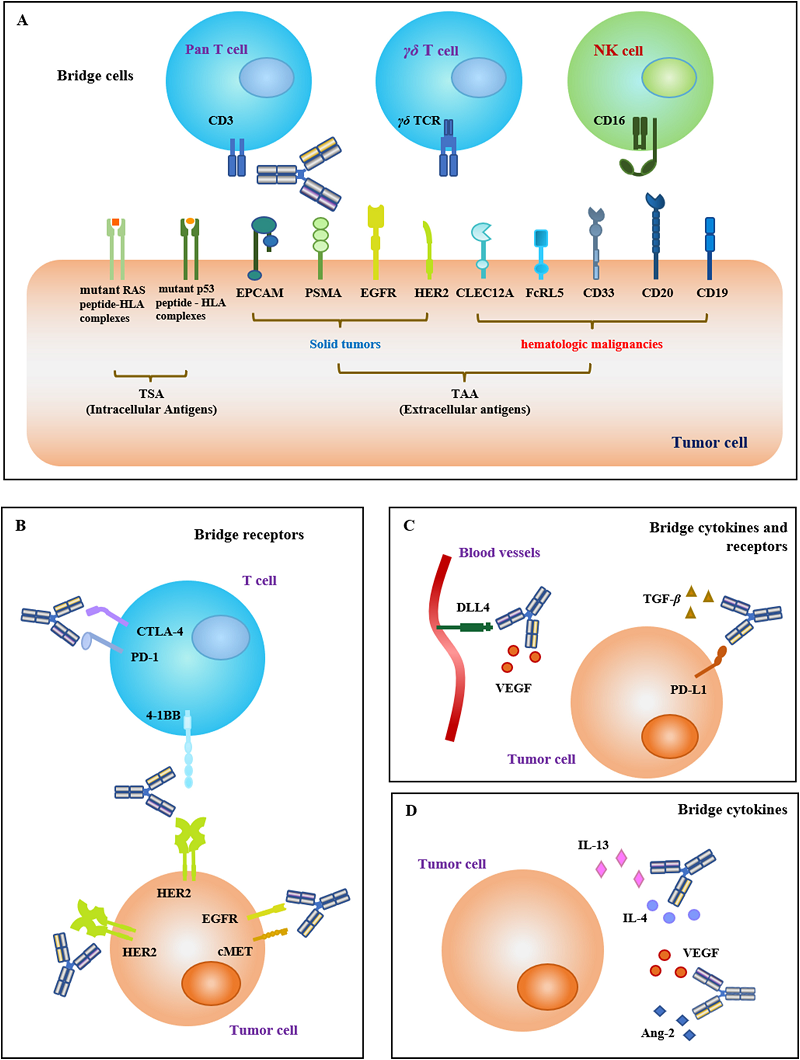
|
Figure 3.
Four categories of BsAbs (bispecific antibodies) used in cancer therapy, based on their mechanism and target selection. (A) BsAbs that bind immune effector cells to tumor cells, including pan T-cells, γδ T-cells, NK cells (natural killer cells), etc. (B) BsAbs that bridge receptors on the same or different cells. (C) BsAbs that bind cytokines and receptors. (D) BsAbs that bridge two cytokines, respectively [50] (CC BY-SA 4.0).
|
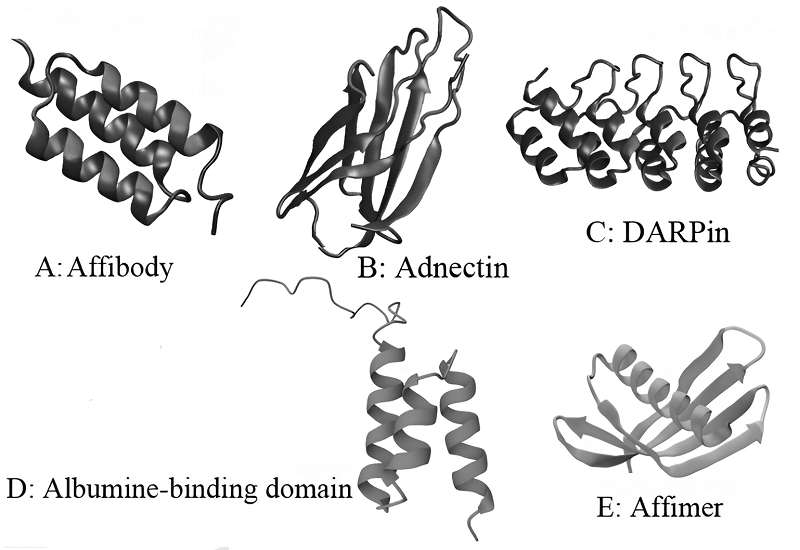
|
Figure 4.
Structures of scaffold proteins. A – affibody (pdbcode: 1q2n); B – adnectin (pdbcode: 1ttg); C – darpin (pdbcode: 1mj0); G – albumin-binding domain (pdbcode: 1GJT), D – affimer (pdbcode: 4N6T), adapted from [69] (CC BY-SA 4.0).
|
|
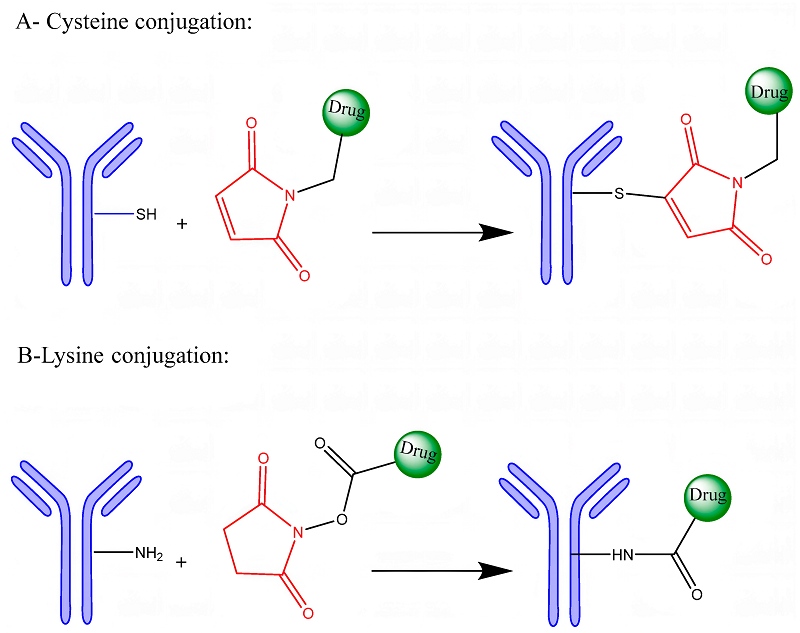
Figure 5.
Two main conjugation strategies in ADC synthesis. (A) Cysteine conjugation: reduction of interchain disulfide bonds leads to the formation of subsequent thiol groups, which react with maleimide-functionalized drug linkers to form stable thioether bonds. (B) Lysine conjugation: solvent-exposed ε-amino groups of lysines react with activated esters (e.g., NHS esters) of drug linkers to form stable amide bonds [105] (CC BY-SA 4.0).
|
|
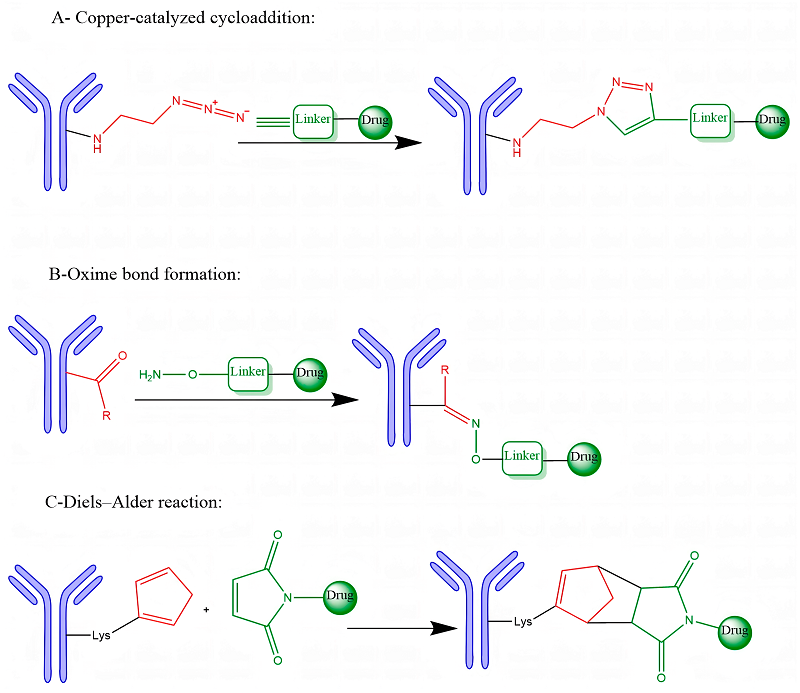
Figure 6.
Schematic illustration of site-specific conjugation strategies for ADCs, including (A) copper-catalyzed azide-alkynine cycloaddition, (B) oxime bond formation, and (С) Diels-Alder cycloaddition, providing selective and stable drug-antibody coupling [105] (CC BY-SA 4.0).
|
|
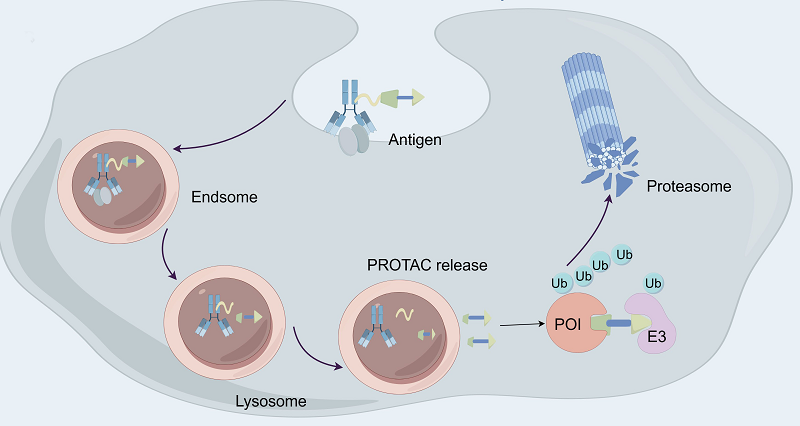
Figure 7.
Schematic illustration of site-specific conjugation strategies for ADCs, including (A) copper-catalyzed azide-alkynine cycloaddition, (B) oxime bond formation, and (С) Diels-Alder cycloaddition, providing selective and stable drug-antibody coupling [105] (CC BY-SA 4.0).
|
|
CLOSE
|
Table 1.
Approved ADC Drugs on the Global Market
|
|
CLOSE
|
Table 2.
Comparative Characteristics and Evolution of Linker Systems in ADCs
|
|
CLOSE
|
Table 3.
Approved ADC Drugs Based on Bispecific Antibodies on the Global Market
|
FUNDING
The work was carried out as part of a state assignment from the Ministry of Science and Higher Education of the Russian Federation on the topic “Technological platform for the development of drug candidates based on alternative scaffold proteins for highly selective delivery of cytotoxic agents to cancer cells” (project No. FMRM-2025-0016).
REFERENCES