PROTOCOL FOR THE PREPARATIVE ISOLATION OF LDL AND HDL FRACTIONS FROM HUMAN BLOOD PLASMA
Institute of Biomedical Chemistry, 10/8 Pogodinskaya str., Moscow, 119121 Russia; *e-mail: gnedenko.oksana@gmail.com
Keywords:blood plasma lipoproteins; LONP, LDL, HDL; high-performance gel chromatography; mass spectrometry identification of apoproteins
DOI:10.18097/BMCRM00327
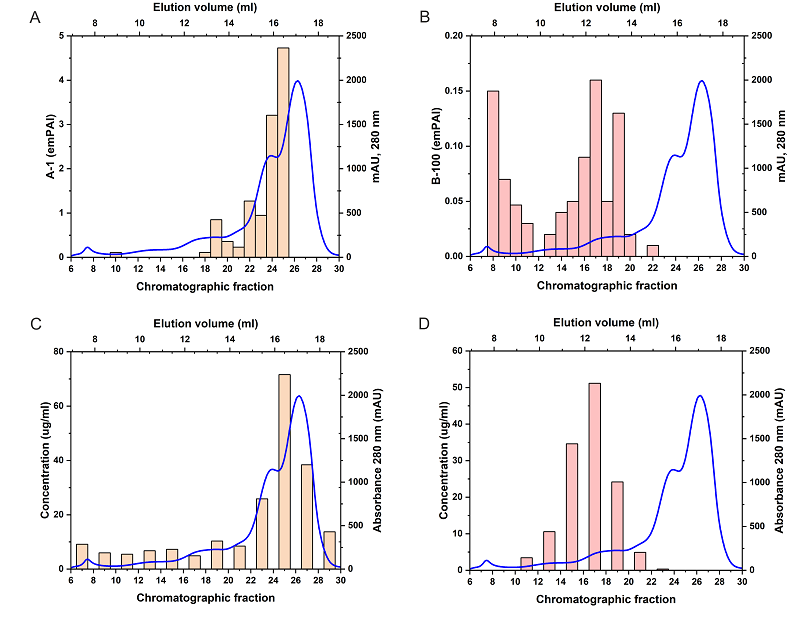
The pathogenesis of atherosclerosis, the main cause of cardiovascular disease, including coronary heart disease and stroke, involves plasma lipoproteins, which differ in protein and lipid composition, size, charge and function. At present, chromatographic methods, in particular gel filtration (SEC), are widely used to isolate lipoproteins. In this article, we present a protocol for the preparative isolation of low-density lipoprotein (LDL) and high-density lipoprotein (HDL) fractions from human blood plasma using gel chromatography. To determine the boundaries of the elution zones of apolipoproteins A-1 and B-100, HDL and LDL markers, respectively, we used liquid chromatography with tandem mass spectrometry (LC-MS/MS) with ELISA cross-validation. Lipoprotein fractions obtained with the help of the SEC can be used for various studies of scientific and applied importance.
|
Figure 1.
Chromatogram of human blood plasma and distribution of A-1 and B-100 in fractions. Blue – chromatogram of blood plasma according to optical density data at a wavelength of 280 nm, yellow – distribution of A-1 in chromatographic fractions according to the emPAI value (A) and ELISA (C), pink – distribution of B-100 in chromatographic fractions according to the emPAI value (B) and ELISA (D).
|
FUNDING
The work was carried out within the framework of the Program for Basic Research in the Russian Federation for a long-term period (2021–2030) (No. 122030100168-2).
REFERENCES
- Tsukahara, T., Tsukahara, R., Haniu, H., Matsuda, Y., & Murakami- Murofushi, K. (2015). Cyclic phosphatidic acid inhibits the secretion of vascular endothelial growth factor from diabetic human coronary artery endothelial cells through peroxisome proliferator-activated receptor gamma. Molecular and Cellular Endocrinology, 412, 320-329. DOI
- Jonas, A., & Phillips, M.C. (2008). Lipoprotein structure. In Biochemistry of Lipids, Lipoproteins and Membranes (D.E. Vance and J.E. Vance eds.) Elsevier, pp. 485-506. DOI
- Yang, L., Fan, B., Yang, K., & Zhu, H. (2012). A simple and sensitive method for lipoprotein and lipids profiles analysis of individual micro-liter scale serum samples. Chemistry and Physics of Lipids, 165(2), 133-141. DOI
- Blanchard, V., Garçon, D., Jaunet, C., Chemello, K., Billon-Crossouard, S., Aguesse, A., Garfa, A., Famchon, G., Torres, A., Le May, C., Pichelin, M., Bigot-Corbel, E., Lambert, G., Cariou, B., Hadjadj, S., Krempf, M., Bach- Ngohou, K., & Croyal, M. (2020). A high-throughput mass spectrometry-based assay for large-scale profiling of circulating human apolipoproteins. Journal of Lipid Research, 61(7), 1128-1139. DOI
- Collins, L.A., Mirza, S.P., Kissebah, A.H., & Olivier M. (2010). Integrated approach for the comprehensive characterization of lipoproteins from human plasma using FPLC and nano-HPLC-tandem mass spectrometry. Physiological Genomics, 40(3), 208-215. DOI
- Kim, K.W., McCormick, J., Helmering, J., Véniant, M.M., & Wang, M. (2008). An optimized fast-performance liquid chromatography method for analyzing lipoprotein profiles using microliter volumes of serum. Analytical Biochemistry, 376(2), 268-274. DOI
- Hirowatari, Y., & Yoshida, H. (2019). Innovatively established analysis method for lipoprotein profiles based on high-performance anion-exchange liquid chromatography. Journal of Atherosclerosis and Thrombosis, 26(12), 1027-1040. DOI
- McConathy, W.J., Koren, E., Wieland, H., Campos, E.M., Lee, D.M., Kloer, H.U., & Alaupovic, P. (1985). Evaluation of immunoaffinity chromatography for isolating human lipoproteins containing apolipoprotein B. Journal of Chromatography, 342(1), 46-66.
- Liangsupree, T., Multia, E., Metso, J., Jauhiainen, M., Forssén, P., Fornstedt, T., Öörni, K., Podgornik, A., & Riekkola, M.L. (2019). Rapid affinity chromatographic isolation method for LDL in human plasma by immobilized chondroitin-6-sulfate and anti-apoB-100 antibody monolithic disks in tandem. Scientific Reports, 9(1), 11235. DOI
- Multia, E., Liangsupree, T., Jussila, M., Ruiz-Jimenez, J., Kemell, M., & Riekkola, M.L. (2020). Automated on-line isolation and fractionation system for nanosized biomacromolecules from human plasma. Analytical Chemistry, 92(19), 13058-13065. DOI
- Hall, M. (2018). Size exclusion chromatography (SEC). In Biopharmaceutical Processing (G. Jagschies, E. Lindskog, K. Łącki, and P. Galliher eds.) Elsevier, pp. 421-432. DOI